Solving Logarithmic Equations
Solving Logarithmic Equations
Recall the inverse nature of logs and exponential functions when solving logarithmic equations.
y = bx is the same as logb(y) = x
Where no base is specified, as in y = log x, a base 10 is assumed. So log x = log10 x. This is known as a common logarithm.
A natural logarithm is one that has a base of e, an irrational number approximately equal to 2.71828. The natural log is written as y = ln x.
Like with exponential functions, logarithmic functions are one-to-one. So if you have a single logarithm on either side of an equation, you can set the inputs (arguments) equal to each other and solve, as long as the bases are equal.
log5(x + 3) = log5 12
x + 3 = 12
x = 9
Properties of Logarithms
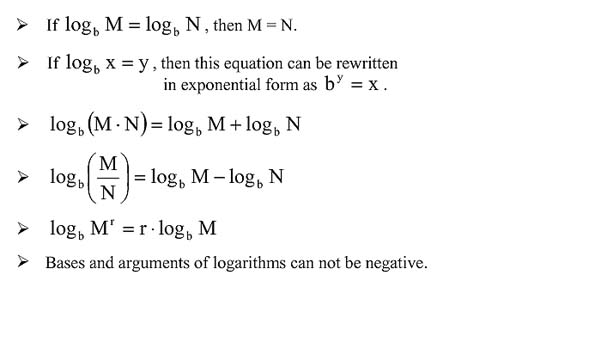
When solving logarithmic equations, consider the following properties of logarithms. Note that these properties apply to logs with the same base.
Example
Solve: log2(x) + log2(x - 2) = 3
Understand
Apply the log rules for same bases to combine the terms on the left hand side of the equation. Once the equation is a log equals a number, convert the logarithm to exponential form.
Solution
log2(x) + log2(x - 2) = 3
log2(x2 - 2x) = 3
23 = x2 - 2x
8 = x2 - 2x
x2 - 2x - 8 = 0
(x - 4)(x + 2) = 0
x = 4, -2
Check Answers
Check to make sure that no answer choice creates a base or argument in the log equal to zero or a negative number.
x = -2 will give a negative number in the argument for the original equation log2(x)
x = 4 will not produce a negative argument
Therefore, the only solution is x = 4.